The Most Important Room in Los Angeles Is a Friend’s House
On kitchen islands, chosen family, and why a photograph of a dinner party is never really about the dinner.
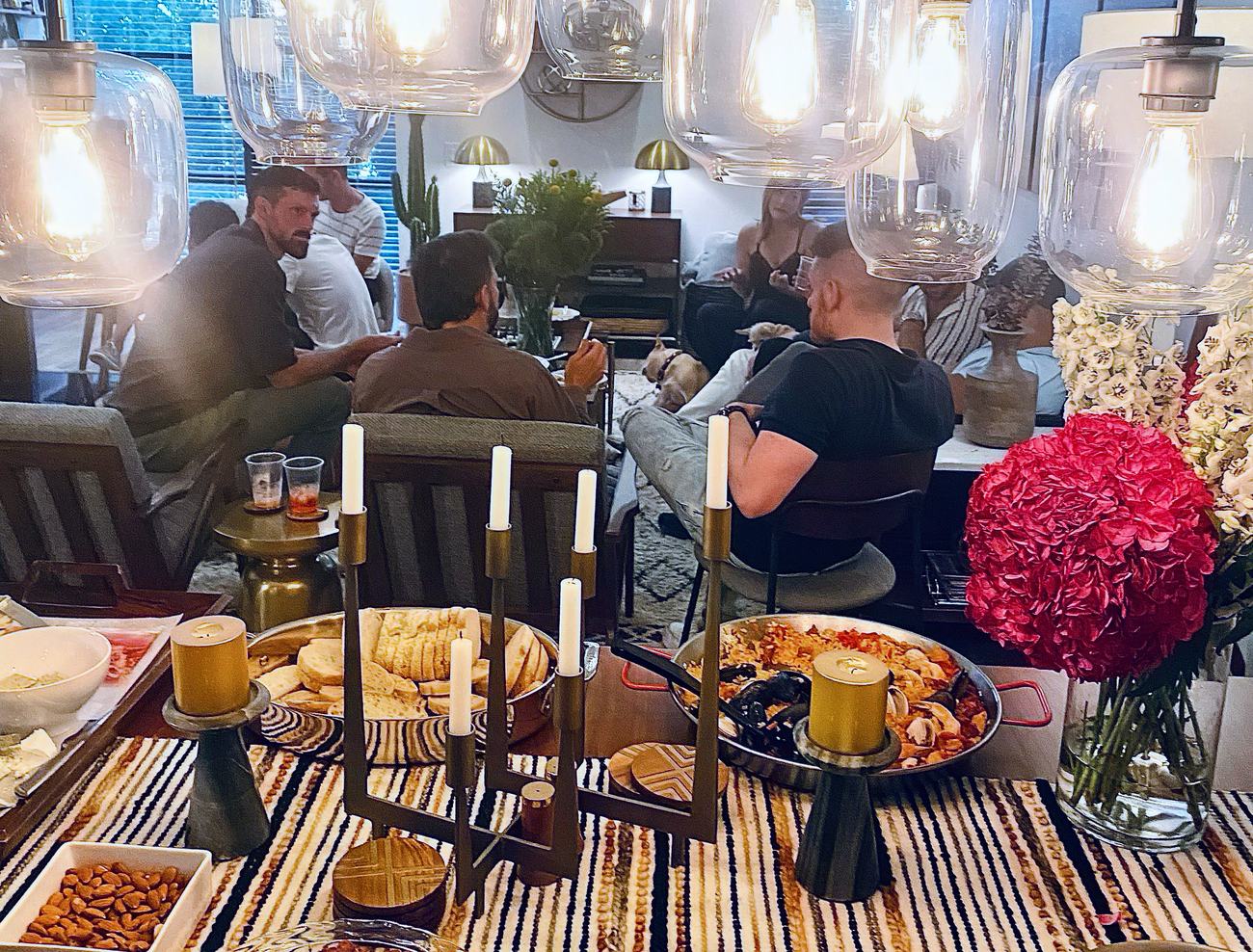
The text goes out on a Tuesday. Twelve people, 6:30, which everyone on the thread correctly understands to mean 7:15. By Thursday it has produced three things: two dietary restrictions, an is it okay if I bring someone, and a question about parking that is really a question about whether he’s driving or taking an Uber, which is really a question about how the night is going to go.
On the night, the table is genuinely chic. Someone spent time on it and it shows. (That person is, usually, me.) For the first forty minutes nobody goes near it. Everyone is standing at the kitchen island, ten feet away, holding drinks. Everyone is always standing at the kitchen island.
Someone arrives late and entirely unbothered, straight from a Barry’s class, still in the clothes. Someone else volunteers his playlist before anyone has asked, phone already out, not because he’s pushy but because he is always prepared and he happens to know his taste is excellent. It is, inevitably, the friend who considers his playlists a body of work. The first half hour is a tasteful, restrained build. By dessert we have arrived at a nine-minute remix of a song that did not require nine minutes, somebody has turned it up, and two people are standing.
Eventually food happens and people sit. High protein, low carb, because this is LA and somebody at that table is four weeks out from something. And then, the part nobody plans and everybody remembers, the whole thing migrates to the couch and the floor and the arm of a chair. It’s almost midnight. The friend that somebody brought is telling a story the room has collectively decided it needs the end of.
A word about where I’m standing. I’m a straight woman, and I’ve spent years in rooms like that one, most of them belonging to gay men, a lot of them in West Hollywood. Guest, plus-one, the person who brought the flowers and stayed afterward to dry the glasses. I’ve also hosted enough of these evenings that I can’t fully switch it off as a guest anymore, which is my problem and not the host’s. At some point you stop watching the table and start watching the room, tracking who has been stranded and who ought to meet whom and whether anybody has said anything true yet.
That’s the subject here. It was never about the dinner.
The dinner party didn’t come back. It got photographed.
The dinner party is not having a moment. People have been feeding each other at home since there were homes. Every family has a version of this, and almost none of them look like the version currently on your feed.
What changed is that the dinner party turned out to be exceptionally good content. Count the photographable objects in a decent one: the table, the candles, the flowers, the ceramics someone drove to Ojai for, the apartment, the outfits, the overhead shot taken at exactly the right moment. A dinner party is a set. It has production design.

But I think we’ve been misreading what those photographs are actually selling. You aren’t only looking at the tablescape. You’re looking at who’s sitting around it. Twelve people in somebody’s home, and the caption doesn’t need to say a word, because the image already said it. This is his inner circle.
Here’s the difference. You can end up in the same nightclub as almost anyone. Same restaurant, same rooftop, same fundraiser, same gallery opening where nobody looks at the art. Proximity in Los Angeles is cheap and endlessly available. But nobody ends up at someone’s dining table by accident. You had to be invited.
And an invitation is evidence. Someone knows you. Someone likes you. Someone thought of you specifically, on a Tuesday, while making a list of twelve. Someone decided the night would be better with you in it.
It isn’t aspirational because the table is beautiful. It’s aspirational because belonging is legible in it.
That’s what’s actually visible in the photograph, and it’s why the genre is so quietly potent. You can see, from the outside, that these people have each other.
The unglamorous math of friendship
Here’s the one piece of research I’d keep if I could keep only one. In 2019 a communication researcher named Jeffrey Hall put hours on friendship. Roughly fifty hours together to become a casual friend. Ninety to become an actual friend. More than two hundred before someone is a close one.
Two hundred hours.
That’s nothing if you sit near someone five days a week, or shared a hallway freshman year, or spent your twenties closing the same bar on Santa Monica. It’s a brutal number if every hour has to be scheduled by two adults with calendars and forty minutes of traffic between them. Hall also found that what you did with the time mattered: meaningful conversation and joking around predicted friendship, while small talk, which is most of what adults actually do together, predicted almost nothing.
Which explains something about this city that otherwise makes very little sense. The men I know here are not short of friends. Most have a solid core, often built somewhere else, in another decade, under conditions that produced those two hundred hours without anyone having to try. What they find nearly impossible is adding to it. Not because Los Angeles is unfriendly, but because almost nothing on a normal calendar here generates hours of the kind Hall was actually measuring.
Look at what a normal week here actually offers. Brunch is ninety minutes, and a good share of it goes to the menu, the check, and comparing calendars. A birthday at a bar is too loud for conversation, and if it’s in WeHo your group has dissolved inside an hour, because everyone ran into someone. You can see the same guy at the gym three times a week for four years and know his entire training split and not his last name. Not his first name either. And the group chat, which everyone treats as a friendship, is really a preservative, superb at holding a relationship at exactly the temperature it already has, indefinitely, for years.
None of which is a knock on any of it, the bar least of all. A great night out does things a dinner never will, and the stranger who is your best friend for four hours is one of the real pleasures of this city. It just isn’t how hours accumulate.
Then a lot of work moved home and stayed there, taking a whole category of time with it. The walk to get coffee. The ten minutes before a meeting actually starts. The conversation that happened only because two people were in the same place anyway. None of it was scheduled and none of it felt like effort, which is precisely what made it work. That time wasn’t incidental to friendship. It was the friendship, before anybody thought to call it that.
So now you have to manufacture on purpose what used to arrive by accident. A long dinner is very good at this, for an unromantic reason. Nobody can sustain small talk for four hours. It collapses in hour two, and something truer moves in to fill the space. Twelve people around a table is a different technology: one conversation instead of six, long enough that hour three arrives, and repeatable in a way Saturday night mostly isn’t.
The room that had to be invented
The beautifully lit dinner on your feed this week belongs to a much older tradition than its lighting suggests, and that tradition was never mainly about food.
When the Mattachine Society, the first sustained gay rights organization in the country, began in 1950, it began in a Los Angeles living room. Not a hall, not a church basement. Somebody’s front room, because there was no other room available.
That was the pattern for most of the century. Gay social life in America ran through private homes, not as a charming preference but as infrastructure: the Harlem rent parties that were simultaneously rent money and nightlife, the apartments George Chauncey maps in Gay New York, the networks the anthropologist Kath Weston would later document as chosen family. Who had a home to gather in, and what it cost him, was always a question of race and money.
None of those rooms were automatically safe, and a man hosting twelve friends tonight is not doing what a man hosting twelve friends in 1956 was doing. Thank God. But the form outlasted the necessity, which is the part worth noticing. It persisted because it worked.
And it says something odd about the home. It’s the most ordinary space we have and one of the most socially powerful, and those two facts are related. Nothing is at stake in a living room. Which is exactly why so much can happen in one.
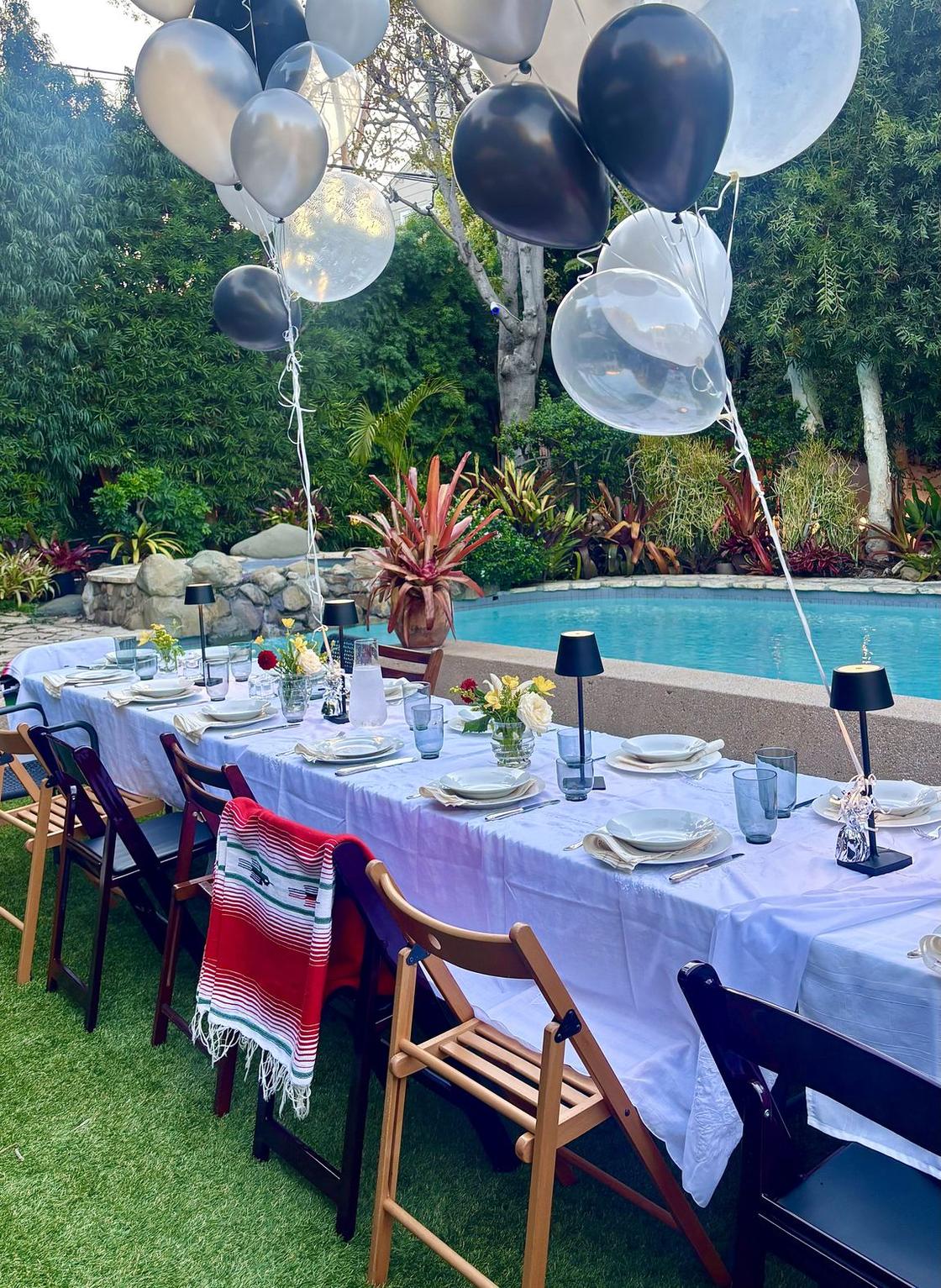
A beautiful dinner and a good one are not the same dinner
None of that happens automatically. The internet has gotten genuinely excellent at showing you how to make a dinner party look good. There are tutorials. There are color palettes. You can buy the exact taper candles. What none of it can show you, because it isn’t visible and doesn’t photograph, is how to make a room feel good.
I’ve been to flawless dinners that were socially inert. Beautiful apartment, faultless table, twelve accomplished people, and a distinct sense by ten o’clock that everyone was performing a version of himself he’d already road-tested elsewhere. Nobody was rude. Nobody was bored, exactly. Nothing happened. People left at a reasonable hour, which is the surest sign a dinner party has failed.
Expensive flowers do not produce vulnerability. A perfectly plated first course does not make two strangers realize they should know each other. And a room full of impressive people is not the same thing as a good room. Sometimes it’s the opposite, because the more impressive the guest list, the more everyone’s incentive is to hold his shape.
The actual craft of hosting is almost entirely invisible, and most of it happens before anyone arrives. Who’s invited, and why those twelve. Whether the group has real chemistry or is just a collection of résumés that happen to be free Thursday. Whether everyone already knows everyone, which makes for a pleasant evening that produces nothing, or whether there’s enough permeability that a new person can actually land. Whether the host makes an introduction properly, with the one piece of context that gives two people somewhere to start, instead of saying two names and walking away.
The guests build it too, which is the thing no restaurant can reproduce. At a restaurant you buy an evening, fully formed and expertly lit, and your job is to receive it and split the check. At someone’s house the one who cooks, the one who takes the playlist too seriously, and the one who brings a friend nobody has met are all making the night while it happens. That’s not service, it’s contribution, and contribution is how people come to feel they belong to something rather than attend it.
And then the hardest part, which no host can manufacture and every host can invite. Whether the room is safe enough that somebody will say a true thing first, and whether anyone answers when he does. One person goes slightly past what the setting requires, someone else matches it, and the temperature of the room permanently changes.
Assembling people is not the same as connecting them. The conditions are the work, and the work is invisible to everyone it works on.
A friend’s house
Which is why any of this is my business, and where the name came from. FriendsHAUS is named for a friend’s house, and I mean the function of one, not the aesthetic.
Think about what happens across a series of them. You get invited once, which is different from being included, and everyone knows the difference. You come back. The second time you aren’t a guest, you’re someone who has been there. You meet his friends, the ones who exist outside the context you know him from. Somebody says you two should talk, and is right. Then you run into that person somewhere else and there’s already a shorthand, because you were both in the room the night the story got told. He turns up at the next dinner. Eventually he texts you directly about something that has nothing to do with the person who introduced you.
And then, with no announcement at all, he stops being your friend’s friend and is simply your friend.
That progression is the entire thing. There’s no such thing as a spectacular interaction that produces a friendship. It’s proximity, repetition, gradually increasing honesty, and a shared history that accumulates one evening at a time until you have inside jokes, which is just a compressed way of saying you have a past together.
A friend’s house generates all of those conditions at once and without appearing to try, which is why it has outlasted nearly every other social form we’ve come up with. The only problem is that not everyone has reliable access to one. That isn’t a character flaw. It’s a logistics problem, and especially acute in a city where everyone you like lives forty minutes away and the social gravity pulls relentlessly toward the large, the loud, and the photographable.
The idea was simply that if a friend’s house is where this happens, the useful thing to build is the house.
The rooms that actually matter
Los Angeles is very clear about which rooms are supposed to count. The members’ club with the waitlist. The restaurant opening. The premiere. The party you had to be on a list for. This city runs on the premise that importance is something you gain entry to.
And then there’s a friend’s house, which is not impressive at all. No door policy. Bad parking. A bathroom where you have to jiggle the handle.
But run the tape on your own social life and notice where the consequential things actually happened. Where you met the person who became your closest friend. Where somebody said you two should know each other, and was right. Where the guy who arrived knowing two people left knowing six. Where one invitation turned into another invitation, which turned into a standing thing, which turned into a decade.
Nobody misses dinner. The food is usually fine. What people miss is the hour after the evening was supposed to end. The story that’s too long for a bar and exactly the right length for a table. The badly underrated feeling of being expected somewhere, of your absence being noticed, of a chair having your name on it in someone’s head before you arrive.
And the moment, which never announces itself and is only ever visible afterward, when someone stops feeling like a person you met and starts feeling like a person you know.
That has always needed somewhere to happen. In this city, it has almost always been a friend’s house.
Sources
Hall, J. A., “How many hours does it take to make a friend?” Journal of Social and Personal Relationships, 2019 · Chauncey, G., Gay New York, Basic Books, 1994 · Weston, K., Families We Choose: Lesbians, Gays, Kinship, Columbia University Press · Library of Congress, The Mattachine Society · Gotham Center for New York City History, “Black Lady Lovers in Prohibition-Era New York”

J’Net Nguyen
Founder, FriendsHAUS
She writes from West Hollywood, surrounded by gay men who came for the wifi and stayed because she kept introducing them to each other.
More about J’NetIf you would like a room like that and do not currently have reliable access to one, that is the whole reason FriendsHAUS exists.